


Membership sharing happens because of how credentials are designed, not because your members are dishonest.
When you hand someone a key fob that works for whoever holds it, you've given them something designed to be passed around. PIN codes get texted to friends, QR codes get screenshotted and shared, and how you have a system where sharing is easier than not sharing.
For a gym with 400 members paying an average of $69 monthly, if just 10% share credentials with one person each, that's 40 unauthorized users. That’s nearly $33,000 in annual lost revenue.
The solution: stop sharing through architecture, not surveillance. In this article, you’ll learn how to create automated detection that flags suspicious patterns without staff watching cameras all day.

Before you can fix a problem, you obviously need to know how bad it is. The fact is, a lot of operators have no idea at what level credential sharing is taking place in their facility, but there are ways to find out.
The most obvious sign of sharing is two people entering when only one credential was scanned. Modern access control systems with camera integration can flag this automatically, so the video shows two bodies, but access log shows one scan.
An important distinction here: tailgating, which we’ll cover in more detail below, looks different from sharing. Tailgating is someone following through an open door, while sharing is someone handing off or using a borrowed credential. Both result in unauthorized access, and both are detectable if you're comparing video with access logs.
Usage patterns #
The next step is pulling your access logs and looking for patterns that don't make sense. If one member's credential was scanned 45 times in a month, but they only paid for one membership, then that’s a red flag.
Also look for impossible timing such as a credential exiting the gym at 11pm, then entering again at 6am the next morning or you can also check for off-peak usage spikes that don't match a member's historical pattern (although take this with a grain of salt).
Most gym access control software has built-in reporting that shows usage frequency, entry times, and patterns over weeks or months. If yours doesn't, you're missing visibility into your actual revenue.
Audit current access vs. membership count #
Finally, the fastest and simplest way to detect membership sharing is this: how many active credentials are in your system versus how many active paid memberships do you have? If you have 400 members but 480 active credentials, you've got a problem, so you need to compare credential activations to membership dates.
A credential that's older than the member's signup date means someone else is using it or it was issued twice. A credential that stayed active after a membership expired means nobody deactivated it manually.
4 ways to prevent multiple people using one gym membership #
Modern access control stops sharing by changing how credentials work, not by adding security layers that slows everyone down. Here are four simple ways to do that:
Mobile credentials #
Mobile credentials work, because the credential lives in an app on one registered phone, not a card that can be handed off. To share access, you'd have to give someone your entire phone, which hardly ever happens.
The upside is that members already bring phones to the gym for music and tracking, so there's no new behavior required. If a phone is lost or stolen, you deactivate the credential remotely in seconds. Additionally, onboarding a new member is very simple: they download the app, verify their phone number, tap the reader to unlock, et voila.
Anti-passback rules #
Anti-passback is a security setting that tracks whether someone has entered or exited a space. Meaning, once you scan in, your credential won't unlock the door again until you scan out. This prevents the classic move where a member scans in, then passes the fob back outside to a friend waiting in the parking lot.
This is great, because for legitimate members, nothing really changes. Also, the system handles edge cases automatically, so if someone forgets to scan out, it auto-resets after 12-24 hours so they're not locked out next time.
Tailgating detection #
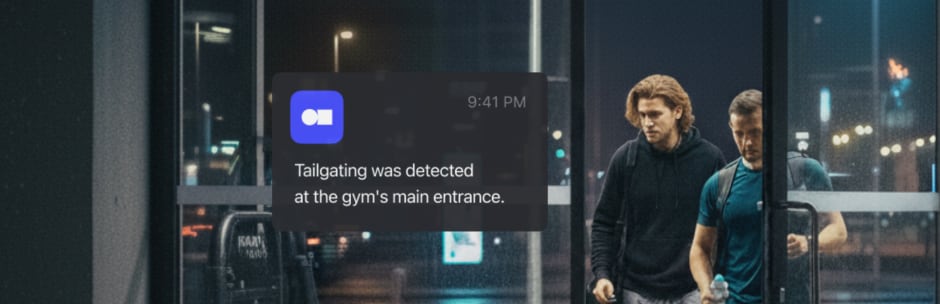
With tailgating detection, the system compares video footage with access logs. Let’s say two people enter, but one credential is scanned. In that case, an alert is sent immediately.
You can also adjust alert sensitivity based on your staffing model (e.g. real-time alerts if someone's on-site, daily summaries if you're fully unmanned). For example, Kisi's tailgating detection uses AI-powered cameras that integrate directly with access control, comparing video analytics with entry logs to spot unauthorized access in real time.

Close security gaps at the door
Detect follow-ins and unauthorized access in real time.
Billing integration #
Another way to control membership sharing is through billing integration, which connects your access control system directly to your gym management software.When payment fails or the memberships expire, then access suspends automatically. This eliminates the "forgot to turn off their access" revenue leakage and removes manual admin work from your staff.
Revenue Impact and ROI #
The math is very simple: if you're losing $33,000 annually to credential sharing, a $25,000 access control investment pays for itself in less than a year. Year two and beyond, that's pure recovered revenue.

Take control of membership sharing with Kisi #
Membership sharing costs gyms real money every year, but the fix isn’t piling down on surveillance or confronting members 24/7. Instead, try redesigning how access works within your facility.
Modern access control (which uses mobile credentials, anti-passback rules, automated tailgating detection, and billing integration) will make sharing structurally harder than paying for that membership.
Kisi's access control platform does all of this without requiring a technical team to maintain it. Mobile credentials work across iOS and Android, anti-passback prevents the classic pass-back move, tailgating detection flags unauthorized entry automatically, and billing integration turns off access the moment a payment fails or membership expires.
The investment typically pays for itself within the first year, and, after that, every recovered dollar is profit. If you're running a gym (especially a 24/7 unstaffed gym) credential sharing isn't a member behavior problem you have to accept. It's an access architecture problem you can solve.

Ana Coteneanu
Content writer @ Kisi | Ana focuses on long-form content that explores access control, space monetization, security, and modern workplace operations. With a background in technology-driven industries, she specializes in turning complex topics into practical insights for business audiences.
