


Reformer Pilates is having a huge moment right now. So much so, that bookings for reformer classes grew 66% year over year, and Pilates has held the title of most-booked, most-rebooked category on ClassPass for three years running.
That growth puts pressure on the door, too. Eight to twelve reformers in one room is tens of thousands of dollars of equipment, often watched over by one or two staff covering hours that used to need a full front desk, and a key for every instructor and a fob for every member stops making sense once bookings, cancellations, and no-shows are happening constantly.
In this article, you'll learn how a door entry system can improve your studio, the different types available, and how to tie all of it into the booking software you're probably already using.
What is a door entry system for reformer pilates studios? #
A door entry system replaces physical keys and fobs with software-managed, electronic access. Instead of cutting a new key every time someone joins or leaves, you grant and remove access from a dashboard, and the door responds instantly.
The setup is the same one you'll find across most modern fitness spaces and consists of:
- Reader: the device at the door that reads whatever credential someone presents
- Controller: the hardware that takes that signal and decides whether to unlock. For example, a Kisi Controller Pro can manage up to four access points on its own, which covers most studios with a front entrance plus a couple of interior doors.
- Credentials: whatever the person is using to get in, mobile, card, fob, or a temporary QR code for a one-off visit.
- Software: the dashboard where access rules are, and where you set who gets in, when, and through which door.
Most of these systems run in the cloud now, which means access can be changed from a phone without driving to the studio.
Why reformer pilates studios need controlled entry #
Studios don't always have someone at the front desk #
The fastest-growing reformer studios right now aren't adding staff at the same rate they're adding members. A lot of them are explicitly designed to run without anyone at the front desk during early mornings or other off-peak hours, with check-in handled entirely through an app.
None of that works with a physical key, but mobile access does, because it doesn't require anyone to hand over a credential in person. A client unlocks the door with their phone, the system checks that they're allowed in at that hour, and that's it.
Access can be tied to bookings #
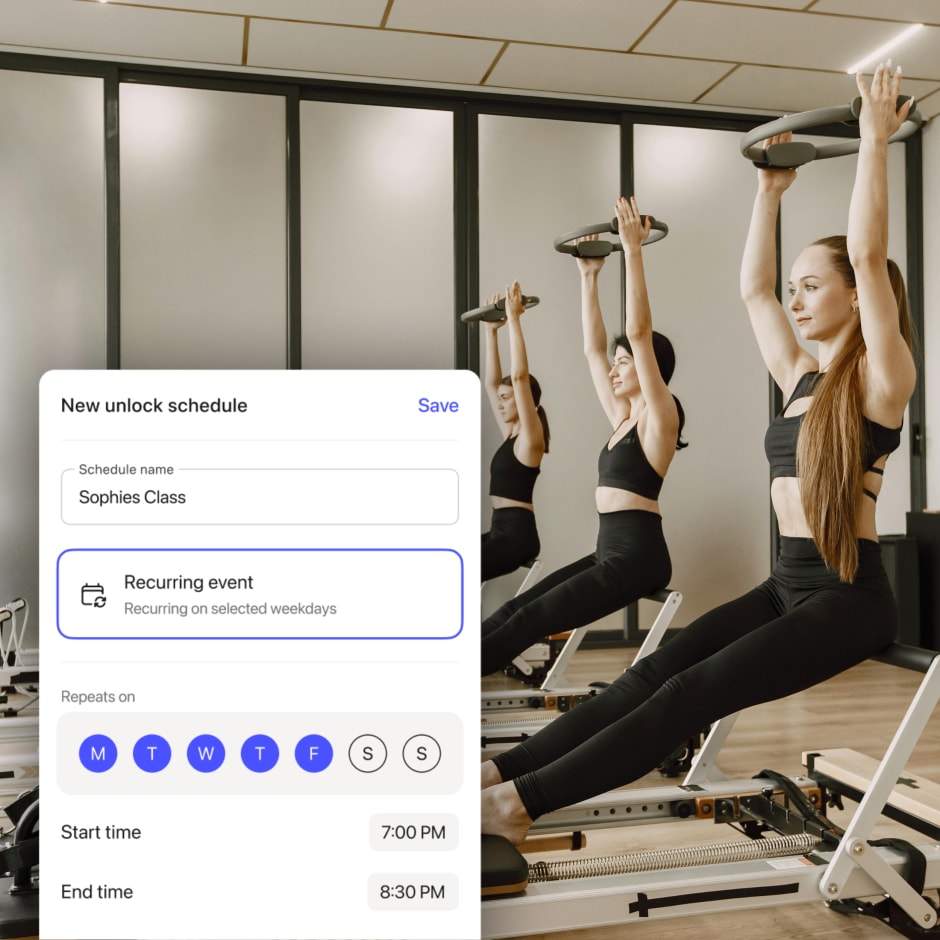
If you think normal access control is not for you because you think most systems just check one thing (is this person a current member or not), there is a solution for that. For example, a membership-only access system will happily let in someone whose booking was cancelled an hour ago, or someone who's shown up two hours early for a slot that isn't theirs yet. Tying door access to the booking system itself, not just to membership status, closes that gap. When a client books a session, books a different session, or no-shows and gets bumped, their access updates with it.
Expensive equipment should be protected #
A single commercial-grade reformer runs for quite a lot and insurance providers treat this seriously too. Property coverage for Pilates studios specifically calls out reformers and other apparatus as a major exposure, separate from general liability.
A door entry system doesn't replace insurance, but it does two practical things: it keeps people who aren't supposed to be in the building out of it, and it leaves a timestamped record of who came through which door and when. If a reformer turns up damaged after hours, that log is the first thing you'd check.
Less time spent managing keys #
A lot of reformer studios run lean. The owner might also be the lead instructor, which means time spent reissuing a lost fob or manually shutting off a former client's access is time not spent teaching. When a membership lapses or someone cancels, that should be the end of the story, not the start of a follow-up task to physically retrieve a key or deactivate a card.
With access tied into a studio management platform, this resolves itself. A new sign-up gets access automatically. A cancelled membership loses it just as fast, without anyone needing to remember to do it.
Types of entry systems for reformer pilates studios #
Once you're looking at access control, the actual decision of what to pick for your studio comes down to credential type. Note that none of these are mutually exclusive, since most studios end up mixing two or three.
Mobile access #
Mobile credentials is the most popular and obvious choice because it lets people unlock the door with their phone or smartwatch, something that each member usually has on their person at all times. Reformer sessions are quiet by design, and someone fumbling with a card reader or knocking to get let in mid-session breaks that. A phone tap is silent and it also solves the staffing problem directly, since there's no one who needs to be physically present to hand over a key.
Keypads and PIN codes #
A keypad is also a very simple and quick option and still common for instructor-only doors or storage areas. The tradeoff is that codes get shared, which is exactly the kind of thing a studio with paying clients wants to avoid. It's a reasonable choice for a low-stakes backroom door, but less so for the main entrance.
Proximity cards and fobs #
Cards and fobs are still a choice among studios, often for clients who'd rather not rely on a phone, or for facilities that are maybe migrating from an older system. They work the same way a phone credential does, just in a physical form. The downside is the same as any physical credential: if it's lost, someone has to deactivate it and issue a new one.
QR codes for drop-ins and trials #
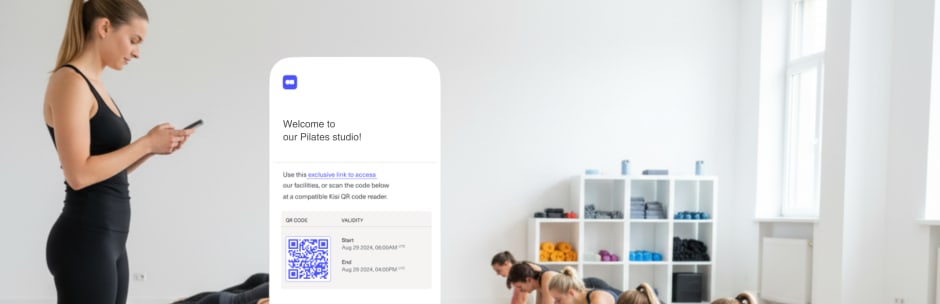
For trial classes, workshops, or one-off bookings, a QR code that expires automatically after use is usually the cleanest option. It’s also quick from an administrative point because there is no account setup, no app download involved, and members just receive a code sent ahead of the session that gets them through the door once.
For example, Kisi's Terminal Pro handles this at the door, and for visitors who show up without a booking at all, Intercom Pro lets them call in so a staff member or instructor can let them in remotely.
Integrating access with your studio management software #
As easy as credential work in access control, they are only half the story if you want a fully seamless experience for your members. The other half is whether the door entry system talks to whatever management platform you're using to run the studio day to day (e.g. Mindbody, ABC Glofox, or TeamUp).
When that integration exists, access stops being something you manage separately. That means:
- When a new client signs up in your booking software, they gets a credential automatically
- If someone cancels or their payment fails, then access ends without you touching the door system at all.
Instructors can also be set to a different schedule entirely, more exactly full-day access regardless of what's booked, while clients only get in during their actual session window.
Also, it’s worth checking what happens with your existing hardware before assuming a full replacement. For instance, if the studio already has electric locks installed, adding a controller is often enough to bring the door onto a cloud system, and a Wiegand board lets you keep current readers and credentials while making the switch.

Keep the door as simple as everything else in the room with Kisi #
A reformer studio runs on precision. Unfortunately, the door is sometimes one of the few parts of that experience that's still, in a lot of studios, running on a system from decades ago. Kisi works with the booking platforms reformer studios already use, so access updates the moment a class is booked, cancelled, or paid for, without anyone touching a key or a card. For studios running early hours, late hours, or no front desk at all, that's often the thing that makes the staffing model possible in the first place. If you want to give your studio an upgrade, book a demo to see how a door entry system would fit your current setup.

Ana Coteneanu
Content writer @ Kisi | Ana focuses on long-form content that explores access control, space monetization, security, and modern workplace operations. With a background in technology-driven industries, she specializes in turning complex topics into practical insights for business audiences.
