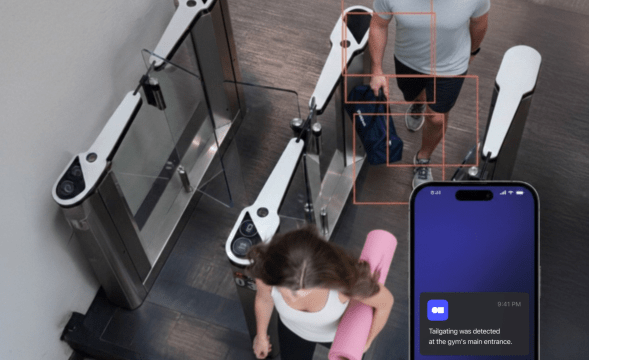


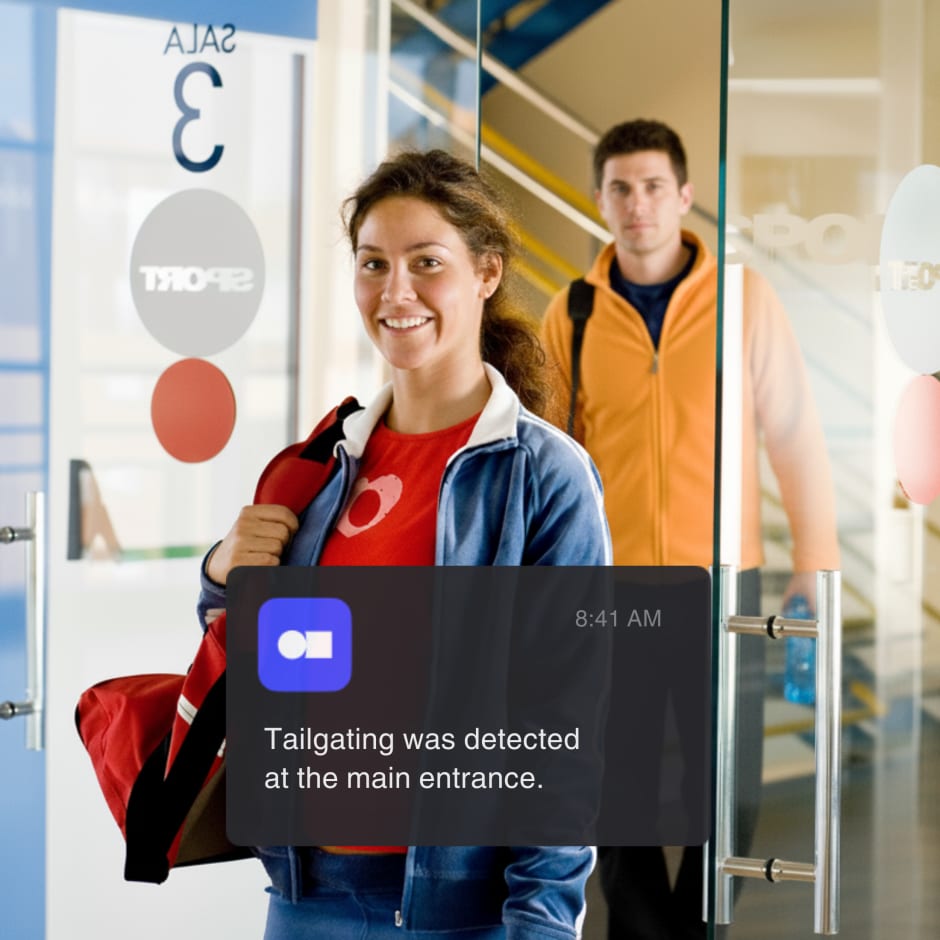
When someone follows a paying member through an entry point without presenting a credential of their own, then that someone is tailgating. This is a practice that has and still is costing gyms revenue.
The most reliable way to prevent it is to combine three layers: entry hardware that admits one person per credential, gym access control that ties every unlock to a verified membership, and AI-based tailgating detection that counts how many people actually walk through after each unlock.
This guide covers everything: how tailgating works, what it costs your gym, and the prevention methods that make sense at different budgets, from a single boutique studio to a multi-location 24/7 chain.

What is tailgating in gyms, and why does it happen? #
As mentioned before, tailgating is straight-up unauthorized physical entry. A person without valid access slips in behind someone who has it. So, a member of your gyms can tap their phone or card, the door opens, and a second person walks through before it closes. Sometimes the member holds the door out of courtesy, other times they don’t even notice.
Now, it’s very important to clarify that tailgating is not the same as membership sharing. Sharing means a non-member uses a borrowed credential, so the system logs a valid entry under the wrong person.
Tailgating produces no log at all, so it’s overall harder to spot in access reports alone. The two problems do overlap and often appear in the same facility, but you need different fixes for each. The cause of tailgating is the same thing that makes modern gyms profitable, which is extended and unstaffed hours.
Maybe a front desk catches follow-ins during the day, but at 11 pm in a 24/7 gym, nobody is likely watching the door, and regulars may know it. Unfortunately, gyms that moved to unmanned operation without upgrading their entry setup are the most exposed.
What does tailgating cost a gym? #
The most obvious direct loss is unpaid entry. Suppose three people tailgate into your facility on an average day and a day pass costs $15. That is roughly $16,000 a year in entries you never billed. The indirect costs, however, tend to be larger:
- Liability: A non-member can get injured on your equipment and has signed no waiver, in which case your insurer will want to know how they got in.
- Member safety and trust: Members paying for 24/7 access expect to know that everyone inside scanned in, and one incident with an intruder during off-hours can undo years of word-of-mouth, which will affect your brand’s reputation.
- Theft: People tend to leave unattended bags or equipment in the changing rooms which usually become the usual targets. Tracing a suspect is difficult when there is no entry record and no name attached to the footage.
- Bad data: Your utilization numbers, peak-hour analysis, and staffing decisions all assume your entry logs reflect reality, and tailgating corrupts all of them.

What would a single tailgating incident really cost?
Estimate the costs associated with uncontrolled entry and access sharing.
How to prevent tailgating in gyms #
Thankfully, there are ways to prevent tailgating in any fitness space. Below are a few, ordered roughly from heaviest to lightest infrastructure. Most gyms end up combining two or three.
1. Install speed gates or turnstiles at the main entry #
The biggest change you can enforce is to install physical barriers at entry points, because they will naturally enforce one-person-per-credential mechanically. Optical speed gates with anti-tailgating sensors detect a second body in the lane and alarm or close. Even better, full-height turnstiles make follow-ins physically impossible.
It’s true that gates cost more than any other option on this list, they take up lobby space, and they slow entry during peak hours. Despite that, they can make a real difference especially for high-traffic urban locations and gyms with persistent tailgating that softer measures fail to fix. That being said, a boutique studio with 200 members rarely needs one.
2. Pair access control with AI-based tailgating detection #
This is the option that has changed most by 2026. You can install AI-enabled cameras at the entry, which integrated with your access control system, can count how many people cross the threshold after each unlock event. If there is one credential, but two bodies, then the system flags the entry, timestamps it, and attaches the footage.
For example, Kisi's tailgating detection works this way. Each unlock opens a short observation window, and person detection with line-crossing analytics tracks how many people actually enter. When the count exceeds the expected number, admins get an alert with video evidence, even if no one is on site.
As opposed to something like a gate, tailgating detection does not physically block anyone, which is exactly why many operators prefer it. Entry stays fast and friendly for members, and you handle violations with evidence instead of hardware. For unstaffed hours, it is the difference between finding out about an incident and never knowing it happened.

3. Use mobile credentials tied to one device #
Another thing you can try are automated entry systems built around mobile credentials that close two gaps at once. A credential locked to a single phone cannot be lent out the way a fob or key card can, and members tend to have their phone in hand at the door, which shortens the open-door window a tailgater needs. Apple Wallet and Android passes also remove the "I forgot my card" door-holding scenario, where staff or other members buzz people in on trust.
4. Enable anti-passback and per-entry rules #
Anti-passback prevents a credential from being used for two consecutive entries without an exit in between, which blocks the pattern where a member badges in, passes their phone back through the door, and a friend badges in seconds later. Per-entry rules in your access control software can also restrict door schedules by membership tier, so an off-peak membership physically cannot open the door at 7 am.
5. Set up real-time alerts for unstaffed hours #
Alerts are what turn detection into prevention. Configure push notifications for tailgating events, doors held open beyond a threshold, and entries at unusual hours. Operators running fully unmanned facilities typically route these to a phone. Staffed gyms can send daytime alerts to the front desk and after-hours alerts to a manager. The Uncaged Fitness team runs exactly this setup: tailgating alerts go straight to the owner's phone, and the gym operates 24/7 without on-site staff.
Tailgating is one of three ways people get in without paying. The other two deserve a quick mention because the fixes live in the same system.
- Lapsed memberships with live credentials: If your gym access control runs separately from your gym membership management software, cancelled and unpaid members keep working credentials until someone remembers to revoke them. Integrating the two closes this automatically: Kisi syncs with platforms like ABC Glofox, Gymflow, Exercise.com, and Gymdesk, so a failed payment suspends door access the same day.
- Credential sharing: Borrowed fobs and screenshotted QR codes produce valid-looking entries under the wrong person. Detection relies on usage patterns and video cross-checks rather than door hardware.
- Propped and held doors: Door-held-open alerts catch the propped fire exit and the delivery door someone wedged with a kettlebell. These events show up in the same dashboard as tailgating alerts, so one system covers both.
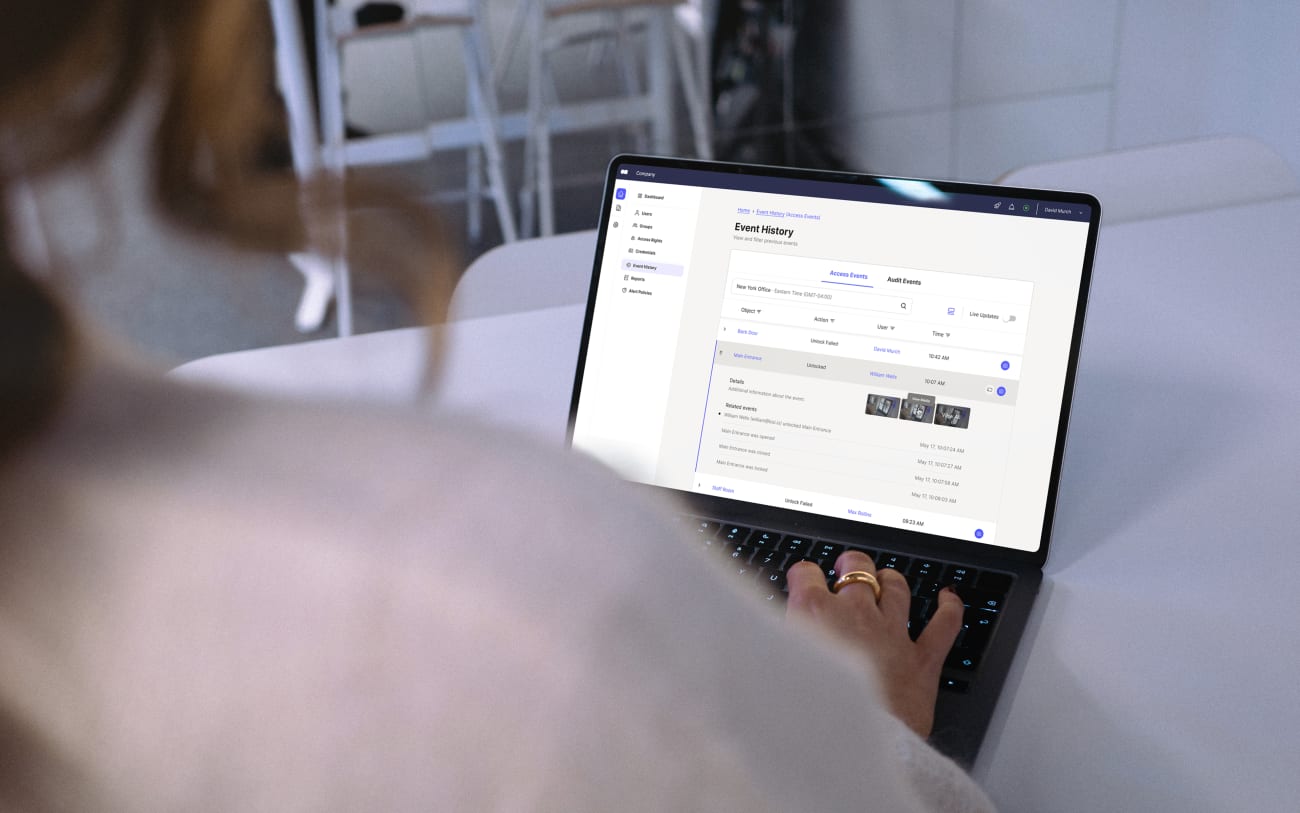
Improve visibility across every entry point
Monitor activity and investigate incidents with greater confidence.
What is the ROI of automated gym access control? #
For most gyms, automated access control pays for itself within the first year, and the single biggest return is staffing, because every front-desk shift you no longer need is worth tens of thousands of dollars annually. Tailgating prevention and recovered entry revenue come on top of that.
The math is easiest to see in an example. Take a mid-size 24/7 gym with around 1,000 members, two access-controlled entry doors, and one overnight front-desk shift it wants to eliminate.
Against that, a full installation for a gym this size, meaning readers, controllers, electric locks, and entry cameras at two doors plus the first year of software, typically lands somewhere between $15,000 and $30,000 depending on hardware choices and door count. At the top of that range, payback arrives in roughly four months.
That being said, your numbers will probably differ. A boutique studio with one door and no overnight shift to cut will see a smaller and slower return, while a multi-location chain compounds the staffing line across every site. The pattern holds either way tho: staffing savings carry the case, extended-hours revenue strengthens it, and tailgating prevention is the layer that makes unmanned operation safe enough to offer at all.

FAQ #
How do gyms detect tailgating? #
The current standard is AI-enabled cameras integrated with access control. Each unlock event sets an expected entry count, video analytics count the people who actually cross the threshold, and any excess triggers an alert with attached footage. Older approaches, like staff watching monitors or reviewing footage after an incident, catch far less and scale poorly.
Do turnstiles stop tailgating? #
Full-height turnstiles stop it almost completely, and optical speed gates with sensors come close. The cost is significant however, and here we’re talking significant hardware, installation, lobby space, and slower entry at peak times. Many gyms get sufficient results from detection plus alerts at a fraction of the price, and reserve gates for locations where tailgating persists.
What is the difference between tailgating and membership sharing? #
Tailgating is physical, so someone follows a member through an open door, and no entry is logged. Sharing is credential-based, meaning a non-member uses a borrowed fob, card, or code, and the system logs a valid entry under the wrong name. Both are unauthorized access, and both are detectable when access logs and video are compared.
How much does tailgating cost a gym? #
There is no reliable industry-wide figure, partly because a lot of tailgated entries leave no record to count. The realistic frame: each tailgater is an unbilled entry (a $15 day pass or a lost membership sale), plus uninsurable liability if they are injured, plus theft risk for your members. For a 24/7 gym, even a handful of daily follow-ins adds up to five figures a year in direct losses before counting a single incident.
Can access control prevent tailgating without turnstiles? #
Yes, through detection rather than blocking. Access control paired with AI cameras flags every follow-in with video evidence in real time, and operators resolve violations through warnings, membership enforcement, or trespass action. Most gyms find that visible detection plus a few enforced cases reduces attempts sharply.
Prevent gym tailgating with Kisi #
Tailgating is not a problem you solve once. It comes back whenever you expand hours, change your entry setup, or your membership grows. The gyms that keep it under control are the ones with a system watching the door when no one else is.
Kisi's access control platform gives gym operators mobile credentials, per-entry rules, billing integrations with leading gym management software, and AI-based tailgating detection that sends real-time alerts with video evidence. It runs the same way at 2 pm and 2 am. Book a demo to see how it works for your facility.

Ana Coteneanu
Content writer @ Kisi | Ana focuses on long-form content that explores access control, space monetization, security, and modern workplace operations. With a background in technology-driven industries, she specializes in turning complex topics into practical insights for business audiences.
