


If you run a gym on staffed hours, your lease covers 168 hours a week and you sell maybe 90 of them, because every open hour has always required a person at the desk.
Automated access breaks that dependency, and once it does, the return builds from three directions at the same time:
- payroll you no longer spend on quiet shifts
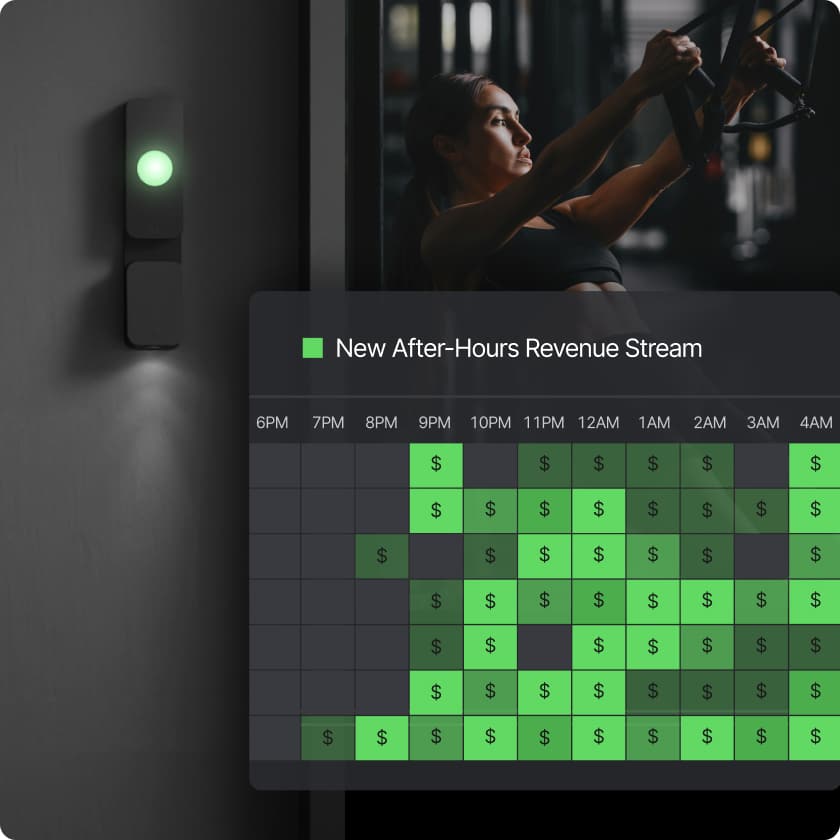
- memberships you can finally sell to people who train at odd hours
- revenue that stops leaking through shared credentials.
For a single-location gym, the investment typically pays for itself in 3 to 12 months, and a facility of around 800 members can expect $40,000 to $60,000 in annual value against a first-year cost of $7,000 to $12,000.
In this article, we’ll walk through the full calculation with real wage data and current hardware prices, so you can swap in your own numbers and see whether the math holds for your facility.
ROI at a glance #
Disclaimer: These figures assume a single-location gym with two controlled doors.
How to calculate the ROI of automated gym access #
If you want to figure out your own gains for improving automation within your fitness facility, the formula is simple: add your annual staffing savings, new access revenue, and recovered losses, subtract the software subscription, and divide by your total first-year investment. Each input is easier to estimate than it sounds, so let's run the numbers for a gym with 800 members paying $69 a month, currently staffed from 5 am to 11 pm.
Staffing savings #
Gym front desk staff in the US earn around $18 an hour on average, and during the early morning and late evening shifts, much of that wage goes toward buzzing in members who have every right to be there anyway.
Dropping four hours, let’s say, of daily desk coverage saves you about $27,000 a year at $18.50 an hour. Disclaimer, you don't have to cut anyone to capture this. Most operators reallocate those hours to sales, retention calls, and floor time, or they simply stop hiring for shifts that no longer need a person at the door.
Recovered losses #
For a 400-member gym charging $69 a month, if 10 percent of members share credentials with one friend each, you're losing nearly $33,000 a year, and most operators have no idea the leak is that large until they compare active credentials against paid memberships. Mobile credentials tied to one verified device, anti-passback rules, and tailgating detection close most of the gap by making membership sharing structurally harder than paying.
New revenue #
Shift workers, healthcare staff, and early risers will pay for a gym they can use, and Health & Fitness Association data shows that extended hours increase off-peak usage by 20 to 30 percent in metropolitan areas. If unrestricted access brings in 25 net new members at $69 a month, you've added about $20,700 a year. Many operators go further and price 24/7 access as a premium tier, which lifts average revenue per member without adding a single new one.
The costs #
A standard commercial access control installation runs $1,500 to $3,500 per door fully installed, which puts a two-door gym at $3,000 to $7,000 upfront, and software licensing adds $30 to $200 a month depending on the platform and features.
Put the example together and you get roughly $55,000 in annual value against $8,500 in first-year costs. Even if you halve every assumption, the system pays for itself within the first year.
Five drivers behind the return #
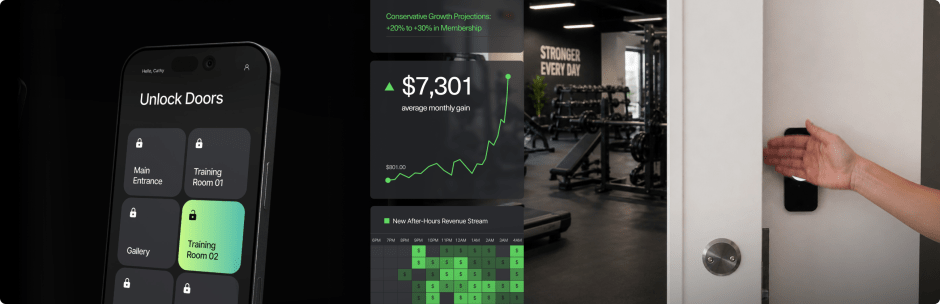
Payroll stops scaling with opening hours #
This is the biggest lever, because in a staffed model every additional hour of access costs an hour of wages, and automation removes that link completely. Some operators take it all the way: Atomic Athlete in Texas runs a fully unmanned gym where access control handles every entry around the clock, with 24/7 access for some membership tiers and restricted hours for the rest.
You start selling hours you were already paying for #
Rent and equipment cost the same whether your doors are open or locked, so every hour you can't sell is fixed cost with no revenue against it. Off-peak members are also the cheapest to serve, since they train when the floor is empty and add no congestion at peak times.`Gyms with extended hours report retention rates 15 to 22 percent higher than staffed-hour models, and keeping a member always costs less than winning a new one.
Some entry methods can do more harm than good. Key fobs can get handed to friends, PIN codes get texted, and QR codes get screenshotted, because those credentials were designed to work for whoever holds them.
During unstaffed hours, tailgating adds a second leak on top, since unpaid guests can slip in behind paying members. Automated access closes both routes by tying every entry to an individual verified credential and pairing entry logs with cameras.
To exemplify, the owner of Uncaged Fitness, a 24/7 facility, used tailgating alerts to catch and remove a member who had been repeatedly bringing in people who weren't supposed to be there, so the disadvantages are definitely outweighed.
Billing integration ends manual access management #
When your access system syncs with your gym management software, a failed payment or cancellation suspends door access the same day, which means no manual credential list, no awkward confrontation at the desk, and no former member training free for how many months because nobody remembered to deactivate them.
The access features that matter most here are real-time membership sync, per-tier permissions, and an audit trail tied to individual members, and the admin hours they recover are a real saving even though they never show up as a line item.
You can sell products a front desk could never police #
Automated permissions make it practical to offer 24/7 premium tiers, early-morning passes, weekend-only memberships, paid day passes, and self-service trials, each of which is incremental revenue at close to zero marginal cost. Enforcing any of these manually would eat the margin they generate, which is why most staffed gyms never offer them in the first place.
The full cost picture #
The reader on the wall is only part of what you'll spend, so budget for all five components before comparing quotes.
- Hardware: readers, controllers, and electrified locks, ranging from roughly $500 per door for a basic keypad to $3,500 for a standard commercial mobile-credential setup.
- Installation: $500 to $2,000 per door depending on wiring complexity. Cloud systems that run on existing Wiegand wiring come in at the low end, and some platforms support self-installation.
- Software: the recurring subscription, typically billed per door or per location.
- Add-ons: tailgating detection requires compatible cameras, which is an extra cost if you don't already have them.
- Credentials: mobile access costs effectively nothing per member, while physical cards and fobs run a few dollars each.

When automated access doesn't pay off #
Naturally, there are some scenarios where automated access doesn’t pay off 100%. For instance, if your particular market has little off-peak demand (and your facility already runs profitability) then automation will most definitely not conjure new members at 2 am. Similarly, a small-town studio whose entire clientele trains at 6 pm gains little from a door that never closes.
Another case is that of (some) boutique studios. If the front-desk relationship is what keeps members loyal, removing it can cost you more in retention than it saves in wages. Automation still earns its keep there through billing sync and security, but the staffing return shrinks considerably.
You also need to think in terms of size. Below roughly 150 members, the fixed costs stretch payback past a year unless your sharing losses are unusually severe. Run the formula with your own numbers before you sign anything, because it takes ten minutes and it will tell you which of these three situations you're in.
Frequently asked questions #
How long does it take to see ROI on gym access control? #
Most single-location gyms reach payback within 3 to 12 months. Gyms that extend to 24/7 hours at the same time get there fastest, because staffing savings and new membership revenue start compounding from day one.
Is 24/7 gym access profitable? #
Generally yes, as long as local demand exists. Your rent and equipment are fixed costs, so every off-peak member is close to pure margin, and round-the-clock access raises what members are willing to pay by an estimated $8 to $12 a month.
How much does automated gym access cost per month? #
Software runs $30 to $200 a month for most platforms, on top of upfront hardware and installation of $1,500 to $3,500 per controlled door.
Do I still need staff with automated access? #
Most gyms keep staff for peak hours, sales, and training, then go unstaffed overnight and in the early morning. Fully unmanned gyms exist and run well, but the hybrid model remains the most common setup.
Grow your gym’s ROI with Kisi #
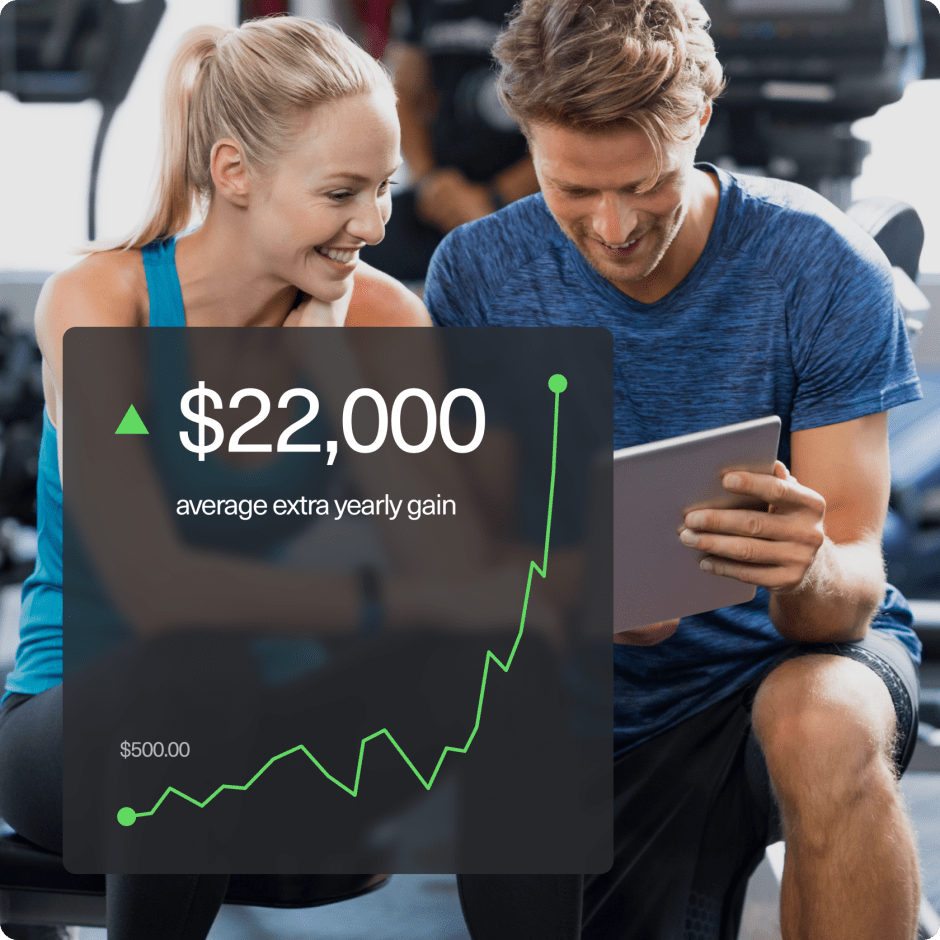
Every gym's numbers look a little different, but once you've run yours, the next step is picking a system that can deliver on them. Kisi offers mobile credentials, anti-passback, tailgating detection, and billing integrations under one digital roof. If you want to see those numbers grow, explore how Kisi works for gyms and across the fitness industry.

Ana Coteneanu
Content writer @ Kisi | Ana focuses on long-form content that explores access control, space monetization, security, and modern workplace operations. With a background in technology-driven industries, she specializes in turning complex topics into practical insights for business audiences.
