


For decades, the standard pottery studio model was an instructor, a class schedule, and a key hanging by the door. Studios opened when the teacher arrived and locked up when the last student left. Naturally, that model still exists, but it's no longer where a part of the industry is and where the rest is headed.
The appeal of pottery is known worldwide, the market was valued at approximately $1.8 billion in 2025 and is projected to grow at a CAGR of 8.1% through 2034. Now, a growing number of pottery studios now run on open membership, where paying members access the space independently, some often around the clock.
With the appeal comes automation and as the model professionalizes, so do the operational requirements, especially since traditional keys no longer hold up in a 24/7 studio with dozens of active members. This guide covers what door entry systems are, why pottery studios specifically need them, and what features matter when choosing one.

What is a door entry system for a pottery studio? #
A door entry system is an access control solution that replaces mechanical locks and keys with electronically managed credentials. What that means is that instead of issuing a physical key to every member, the studio installs electronic locks on its doors and manages who can open them (and when) through software.
The core components of a door entry systems typically are:
- Reader: this is installed at the door and reads the credential a person presents
- Controller: this is the hardware unit that processes the credential and triggers the lock. For example, the Kisi Controller Pro 2 can manage up to four access points from a single device, which makes it suited for studios with multiple doors or zones.
- Credentials: these give members access and can be a smartphone, key cards, fobs, or QR codes.
- Access management software: the cloud platform where studio administrators manage users, permissions, schedules, and entry logs.
Long story short, when a member presents a valid credential, the system verifies their permissions and unlocks the door. If they don't have access rights (because maybe it's the wrong time of day, an expired membership, or a restricted zone), then the door stays locked.
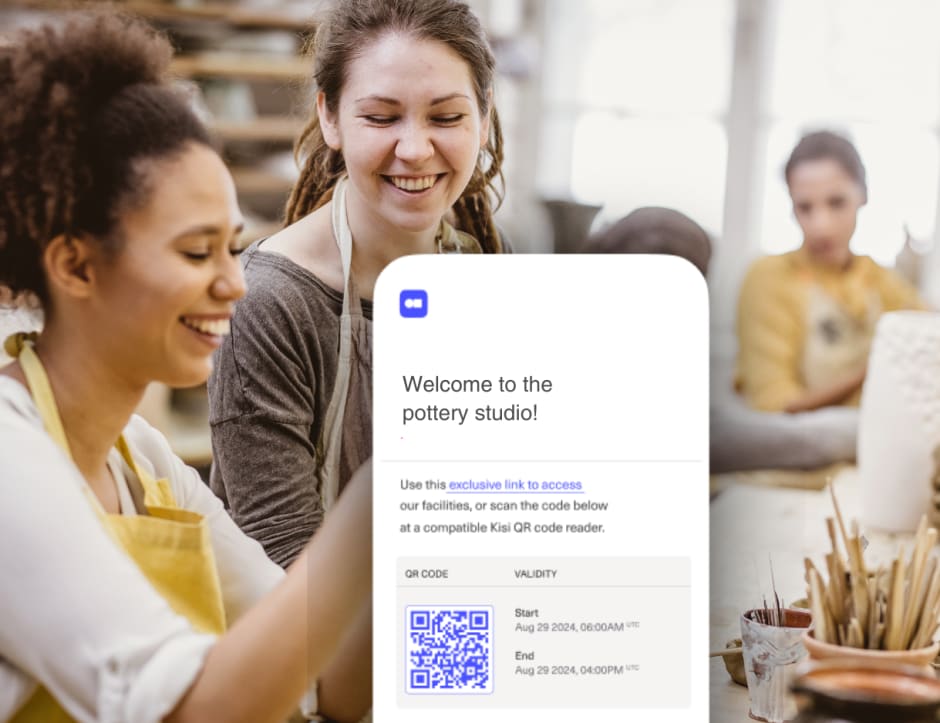
Modern systems are cloud-based, which means you can manage doors remotely, update permissions instantly, and pull entry logs from anywhere. There’s full control on the operator’s end and if you’re running trial memberships, workshops, or one-off events, even temporary credentials such as QR codes can be issued to visitors and set to expire automatically after use.

Modern access starts with choice
Give users more ways to unlock while keeping management simple.
Why pottery studios need controlled entry #
Pottery studios carry a combination of access challenges that other facilities don't and now, a traditional key system just doesn't address any of those things cleanly.
Manage member access and membership tiers #
Most membership-based pottery studios run multiple access types at once. There can be open studio members who might hold rolling monthly or quarterly plans or just class-only members that have access during scheduled sessions. In case your studio holds events, then you’ll also have workshop participants which will only need single-day entry.
Naturally, each of those groups needs different permissions, and those permissions should change automatically when membership status changes. When a monthly subscription lapses or a payment fails, access should stop.
With a door entry system integrated into your studio management software, this happens without manual intervention. A membership created, upgraded, or cancelled updates the corresponding access permissions in real time. Therefore, there's no memberships sharing, former members can't walk in after their plan ends and new members get access the moment they sign up.
Support 24/7 and after-hours access #
24/7 access has become a competitive differentiator for membership studios and a must if you want to maximize revenue for any membership-style facility. Not to mention creative schedules don't follow business hours. Some potters work early in the morning before their day starts, late at night after the kids are in bed, on Sunday afternoons when inspiration shows up uninvited.
Restricting the studio to staffed hours means restricting the membership and therefore restricting your revenue. A door entry system makes unstaffed operation viable, because members unlock with their chosen credential. You set access schedules per user group and the system enforces those rules automatically.

Protect high-value equipment and restricted zones #
A well-equipped pottery studio is a significant investment. Kilns alone range from $2,000 to $8,000 each, and community studios typically run several. If you add everything else and the total value of what's in the building climbs fast.
Beyond the main studio floor, most pottery studios have areas that shouldn't be accessible to all members like kiln rooms, glaze rooms, storage, etc. A multi-zone access system handles each zone and the whole facility cleanly.
For instance, the Kisi Controller Pro 2 manages up to four access points, so you can secure the main studio entrance, the kiln room door, the glaze room, and the storage area from a single device. Each zone gets its own permission rules and entry logs will show you who accessed which area and when ( a useful context to have if something goes wrong).
Reduce front desk dependency #
Pottery studios typically run lean. Many are owner-operated, with part-time instructors and minimal admin staff. Staffing someone at the door for every open studio hour isn't financially realistic, and for a 24/7 operation, it's not possible at all.
Mobile credentials shift the entry process to members. They arrive, unlock the door with their phone, and get to work, and no one needs to be there to let them in. Staff time can therefore go toward teaching, kiln management, and member support rather than door duty.
Features to look for in a pottery studio door entry system #
Access control systems vary significantly in what they can do. These are the features that matter most in a pottery studio context.
Mobile access #
Mobile credentials are a big selling point because they let members unlock doors with their smartphone via Bluetooth or Wi-Fi. There are no physical keys to issue, copy, or chase when someone leaves. Credentials are managed in the software itself, so you create them when a membership starts and revoke them when it ends, and that’s the end of it. For a 24/7 studio, this is the most practical credential type, because members arriving at 6am or 11pm don't need to carry a separate fob, and you're not waiting on anyone to return hardware when they cancel.
Integration with studio management software #
Ideally, your door entry system should also talk to whatever platform manages your memberships, bookings, and payments. Kisi, for instance, integrates with 100+ other platforms, so it has the option to update access automatically when membership status changes.
This integration part also handles temporary access well. A workshop participant who books through your platform can receive a QR code credential that's valid for that session only, without any admin work on your end between booking and arrival.

Entry logs and activity tracking #
A cloud-based system keeps a timestamped record of every credential presented at every door. From an operational standpoint, this tells you when your peak studio hours are, which areas see the most activity, and where quiet periods open up for new programming or discounted access tiers.
From a security standpoint, it gives you an audit trail. If something is damaged or goes missing, you know who was in the building. Especially if you have multiple restricted zones like the kiln room, entry logs are particularly valuable and you can always verify that only authorized members accessed the space and flag anything that looks off.
Simplify access in your pottery studio with Kisi #
Not every pottery studio needs a full access control overhaul on day one, but if you're thinking of an upgrade that will also increase your revenue, then a modern access control system is worth considering. Maybe you’re simply tired of chasing keys and manually updating door codes when memberships change, which is also fair. A modern entry system pays for itself quickly in saved admin time and reduced liability exposure.
If you're looking for a place to start, Kisi offers mobile credentials, zone-level permissions, and real-time entry logs which all managed simply from a single dashboard. Get a demo to see how it works for studios like yours.

Ana Coteneanu
Content writer @ Kisi | Ana focuses on long-form content that explores access control, space monetization, security, and modern workplace operations. With a background in technology-driven industries, she specializes in turning complex topics into practical insights for business audiences.
